Impedance, Sensitivity, and Power Explained
What speaker impedance, sensitivity, and power ratings actually mean, why sensitivity matters more than wattage, and how to match amps to speakers properly.
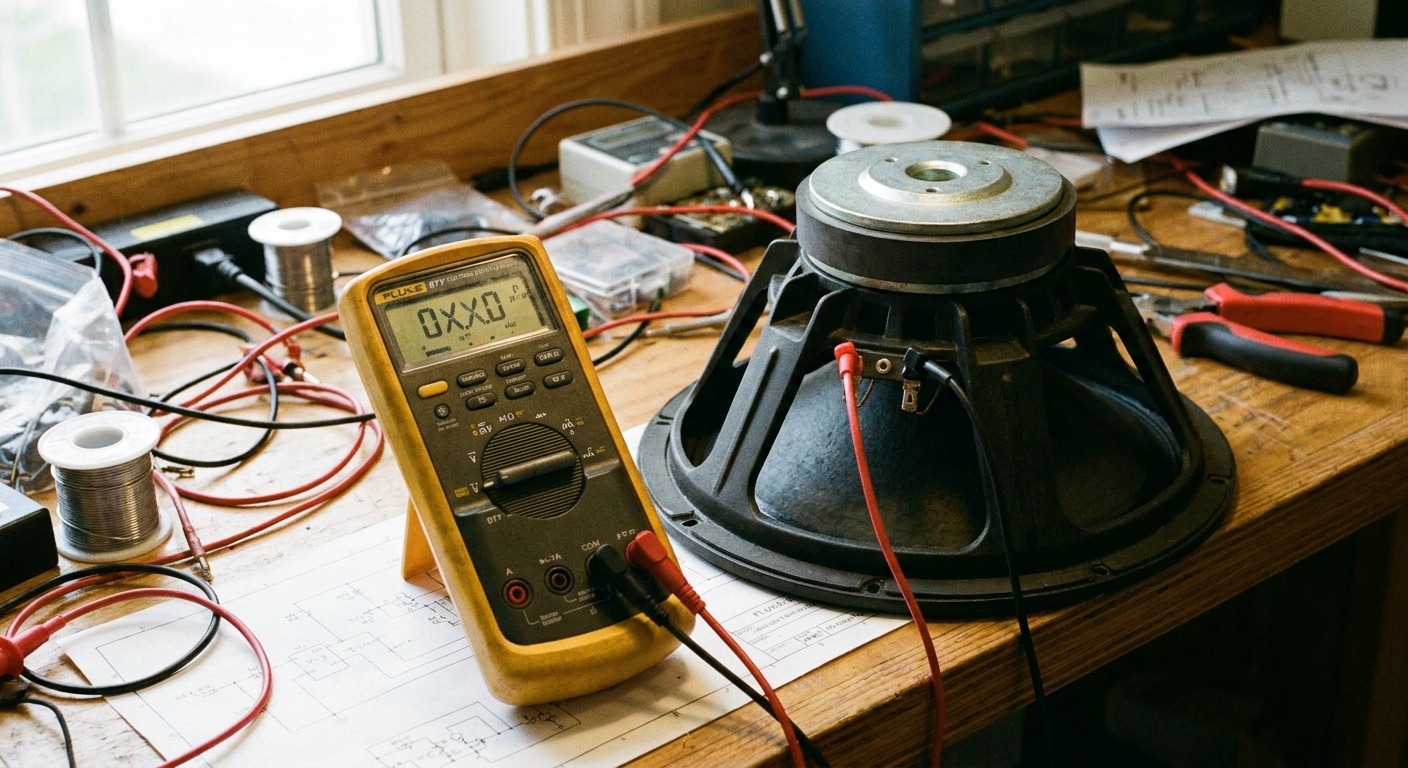
Speaker specifications are full of numbers that most people glance at without understanding. Impedance, sensitivity, and power handling are the three most important, and they are also the three most commonly misunderstood. Getting them right is the difference between a system that sounds effortless and one that clips, distorts, or simply disappoints. Getting them wrong can, in extreme cases, damage your equipment.
This is not complicated once you understand the underlying principles. The audio industry just does a poor job of explaining them.
Impedance: What Ohms Actually Mean
Impedance is the opposition a speaker presents to the flow of electrical current from the amplifier. It is measured in ohms and is the AC equivalent of resistance. Most home speakers are rated at 4, 6, or 8 ohms. Car speakers are typically 4 ohms. Headphones range from 16 ohms to over 600.
The critical thing to understand is that the rated impedance is a nominal value, meaning an approximate average. A speaker rated at 8 ohms does not present 8 ohms of impedance at all frequencies. It might dip to 3.5 ohms at 200 Hz and spike to 40 ohms at its resonant frequency. The impedance curve of a real speaker looks like a mountain range, not a flat line.
This matters because your amplifier has to supply current based on the impedance it sees. Lower impedance means the amp must deliver more current. An amplifier comfortable driving an 8-ohm speaker might overheat or shut down when asked to drive a speaker that dips to 2 ohms. Understanding how speakers work physically helps explain why impedance varies: the voice coil's electrical properties interact with the mechanical properties of the cone, suspension, and enclosure, and these interactions change with frequency.
Impedance quick reference:
- 8 ohms: The standard for home audio. Any home amplifier or receiver can drive these safely.
- 6 ohms: Common in modern home speakers. Most amplifiers handle these without issue.
- 4 ohms: Standard for car audio. Home amplifiers need to be rated for 4-ohm loads. Budget receivers may struggle.
- Below 4 ohms (dips): Demanding load. Requires a robust amplifier with good current delivery. Check the impedance curve, not just the nominal rating.
When a manufacturer rates a speaker at 4 ohms, they are telling you the nominal impedance, but the minimum impedance is what your amp actually cares about. A speaker rated at 4 ohms nominal that dips to 2.8 ohms at certain frequencies is a significantly harder load than one that stays above 3.5 ohms. Reputable manufacturers publish impedance curves. If a company will not show you the impedance curve, that should raise questions.
Sensitivity: The Specification That Actually Matters
Sensitivity tells you how loud a speaker plays for a given amount of power. It is typically expressed as decibels of sound pressure level measured at one metre with one watt of input power (dB/W/m or dB SPL at 1W/1m). A speaker rated at 88 dB sensitivity produces 88 dB of sound pressure at one metre when fed one watt.
This might seem like a minor spec. It is not. It is arguably the most important number on the specification sheet, and here is why: a 3 dB increase in sensitivity is equivalent to doubling your amplifier power. Let that sink in. A speaker rated at 91 dB sensitivity will play as loud with 50 watts as a speaker rated at 88 dB sensitivity plays with 100 watts.
This has massive practical consequences. If you have a modest amplifier, say 40 to 60 watts per channel, a speaker with 90+ dB sensitivity will play cleanly at room-filling volumes. A speaker with 83 dB sensitivity will need 200 watts or more to reach the same level, and your modest amp will clip and sound harsh long before you get there.
If you remember nothing else from this article, remember this: sensitivity matters more than your amplifier's wattage. A sensitive speaker with a modest amp will almost always outperform an insensitive speaker with a powerful amp.
The 3 dB Rule and Why It Matters
The human ear perceives a 3 dB increase as a just-noticeable change in volume. To produce that 3 dB increase, you must double the amplifier power. To produce a 10 dB increase, which sounds roughly twice as loud, you need ten times the power. This is why power ratings on amplifiers and speakers are frequently misleading. That extra 100 watts over a 100-watt baseline buys you exactly 3 dB, barely perceptible, while the marketing department gets to print a bigger number on the box.
The practical takeaway: a pair of speakers with 92 dB sensitivity and 50 watts of power handling will play louder and cleaner with a 50-watt amp than a pair with 84 dB sensitivity and 300 watts of handling. The mathematics are unambiguous.
Power Handling: What It Means and What It Does Not
A speaker's power handling specification tells you how much continuous power it can accept without damage. It is a thermal and mechanical limit, not a performance target. A speaker rated at 100 watts does not need 100 watts. Normal listening levels in a home environment typically require 1 to 10 watts for speakers of average sensitivity. Loud listening might push to 20 or 30 watts in peaks.
This means the idea that you need to "match" your amplifier's power to your speaker's power handling is largely a myth. A 200-watt amplifier paired with a speaker rated at 75 watts is perfectly safe as long as you are not pushing the volume into distortion. In fact, an amplifier with more power than the speaker's rating is generally safer than one with too little power, because an underpowered amp driven to clipping produces distorted waveforms that are more dangerous to tweeters than clean power at higher levels.
Amp Matching in Practice
Matching an amplifier to speakers means ensuring the amp can drive the speaker's impedance comfortably and has enough power for your desired volume given the speaker's sensitivity.
Start with sensitivity. If it is 87 dB or above, a standard 50 to 100 watt receiver works beautifully. Below 85 dB, you need more power. Above 93 dB, even a 10-watt tube amp can fill a room. Next, check the impedance. If the speaker is a 4-ohm design, your amplifier needs to be stable into 4 ohms. Many budget receivers are rated only for 8-ohm loads and will overheat with demanding speakers. The same principles apply in car audio amplifier matching, where 4-ohm and 2-ohm loads are standard.
Quick amp matching guide:
- High sensitivity (90+ dB), 8 ohms: Almost any amplifier works. Even 20 watts per channel is adequate for moderate volumes.
- Average sensitivity (85-89 dB), 8 ohms: A standard 50-100 watt receiver or integrated amp is ideal.
- Low sensitivity (below 85 dB), 8 ohms: Consider a more powerful amplifier, 100 watts and above, for comfortable headroom.
- Any sensitivity, 4 ohms: Make sure the amplifier is explicitly rated for 4-ohm operation. Current delivery matters.
The Numbers the Industry Does Not Want You to Focus On
Manufacturers love to advertise power handling because bigger numbers sell products. They are less enthusiastic about sensitivity ratings because those numbers reveal uncomfortable truths. A flagship tower speaker with 84 dB sensitivity needs serious amplification to perform, which means the total system cost climbs rapidly. A well-engineered bookshelf speaker at 89 dB sensitivity paired with a modest amp might actually play louder and cleaner for a fraction of the price.
The diminishing returns problem in audio is closely tied to these specifications. Once you understand that sensitivity and impedance determine how much amplifier you need, you can make rational decisions instead of chasing spec sheet numbers. A 1,000-watt amplifier is meaningless if your speakers are efficient enough to sound amazing with 50 watts.
Frequency response specifications are similarly misleading. A speaker claiming 35 Hz to 25 kHz sounds impressive until you learn it was measured with a plus or minus 10 dB tolerance. At that tolerance, there could be an enormous hole in the midrange. A more honest spec uses plus or minus 3 dB, and the best manufacturers publish full response curves, as documented on Audio Science Review.
Putting It All Together
When evaluating speakers, read the specifications in this order. First, sensitivity: this tells you how efficient the speaker is and what kind of amplification it needs. Second, impedance: this tells you whether your existing amp or the one you are considering can drive it safely. Third, frequency response: this gives you a rough idea of the speaker's tonal range, though you should not trust a frequency response claim without seeing the measurement conditions. Power handling comes last, and mostly tells you the speaker's upper limit rather than anything about how it sounds.
This knowledge also helps when comparing bookshelf speakers against towers. Towers often have higher sensitivity because of their larger cabinets and multiple woofers, which is a genuine advantage. Bookshelf speakers compensate with smaller size and often better imaging, but typically need more amplifier power per decibel of output.
Understanding these three specifications, impedance, sensitivity, and power, transforms you from a consumer who buys based on marketing into one who buys based on physics. The numbers are there on the spec sheet. The audio industry just hopes you do not know how to read them. Now you do.