Crossover Networks: Active vs Passive
How crossover networks split audio frequencies between drivers, the differences between passive and active designs, filter slopes, and the case for bi-amping.
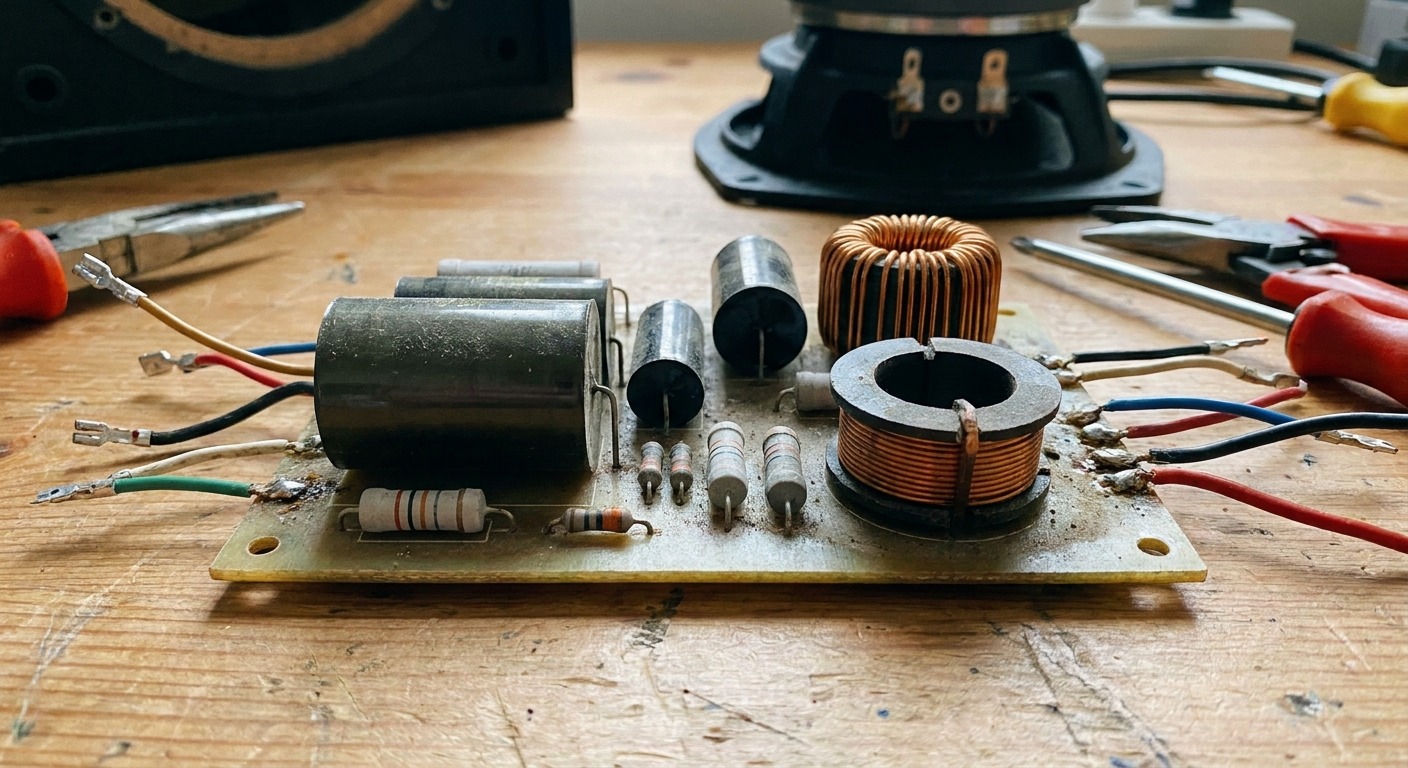
Every speaker with more than one driver needs a way to divide the audio signal so that each driver receives only the frequencies it is designed to reproduce. Without this division, your tweeter would receive bass frequencies that could destroy it, and your woofer would attempt to reproduce treble frequencies it cannot handle gracefully. The component that performs this division is called a crossover network, and the choice between passive and active crossover designs is one of the most consequential decisions in speaker engineering.
What Crossovers Do
A crossover is a frequency-dependent filter network. In a two-way speaker, the crossover splits the full-range audio signal into two bands: low frequencies go to the woofer, and high frequencies go to the tweeter. In a three-way system, there are two crossover points, creating low, mid, and high bands for the woofer, midrange driver, and tweeter respectively.
The crossover point is the frequency at which the transition occurs. In a typical two-way bookshelf speaker, this might be around 2,000 to 3,000 Hz. Below that frequency, the woofer handles the work. Above it, the tweeter takes over. The crossover does not switch instantaneously at one frequency. Instead, the drivers' responses overlap in a transition region, and getting this overlap right is one of the hardest parts of speaker design.
Understanding crossover behaviour helps explain many of the audible characteristics you notice when comparing speakers. If you have read about how speakers work, you know that each driver has physical limitations. The crossover's job is to keep every driver operating within its comfort zone.
Passive Crossovers: The Standard Approach
The overwhelming majority of consumer speakers use passive crossovers. These are circuits built from inductors, capacitors, and resistors, mounted inside the speaker cabinet, that filter the already-amplified signal from your amplifier before it reaches each driver.
A basic first-order passive crossover for a two-way speaker is remarkably simple: a capacitor in series with the tweeter (which blocks low frequencies) and an inductor in series with the woofer (which blocks high frequencies). Higher-order crossovers add more components for steeper filter slopes.
Passive crossovers have several advantages that explain their dominance. They require no power supply and no external electronics. The speaker works with any standard amplifier. Setup is simple: connect two wires and play music. For the consumer, passive speakers are effectively plug-and-play, which matters enormously for market acceptance.
But passive crossovers also have real engineering limitations. The filter components handle the full amplified signal, which means power is lost as heat in the inductors and resistors. This reduces efficiency. The components interact with the driver's own impedance characteristics in complex ways, making the actual filter response different from the theoretical one. And because the crossover sits between the amplifier and the driver, the amplifier has less direct control over the driver's motion.
Passive crossover pros and cons:
- Advantages: No power needed, works with any amp, simple setup, proven reliability, lower system cost
- Disadvantages: Power loss in components, interaction with driver impedance, less precise filter behaviour, amplifier sees complex load, limited adjustability
Active Crossovers: The Technical Ideal
An active crossover splits the audio signal before amplification, at line level, and each frequency band gets its own dedicated amplifier. Instead of one amp driving a passive crossover, you have separate amplifiers for the woofer, tweeter, and midrange, each receiving a pre-filtered signal.
This approach is technically superior in almost every measurable way. The filters operate on low-power signals, so there are no power losses. They can be implemented with op-amps or DSP rather than bulky inductors, allowing precise control over filter shape, slope, and phase. Each amplifier sees a simpler load, which improves control and reduces distortion. Active crossovers also allow equalization, time alignment, and dynamic processing per band. If the tweeter has a resonance at 8 kHz, the crossover can notch it out without affecting the woofer.
Studio monitors have used active designs for decades. If you walk into any professional mastering facility, the speakers are almost certainly active. Engineers whose livelihoods depend on hearing the truth choose active designs overwhelmingly.
Filter Slopes: How Steep Is the Cutoff
Crossover filters do not cut off frequencies like a brick wall. They attenuate gradually, and the steepness of this attenuation is described by the filter's slope, measured in decibels per octave.
A first-order filter (6 dB/octave) is the gentlest slope. One octave above (or below) the crossover point, the signal is reduced by only 6 dB. This means significant overlap between drivers in the crossover region. First-order crossovers have the advantage of perfect phase response (no phase shift between drivers at the crossover point), but the wide overlap means both drivers need to behave well far outside their primary range.
A second-order filter (12 dB/octave) is the most common slope in passive speaker design. It provides a reasonable rate of attenuation while keeping the component count manageable. The trade-off is a 180-degree phase shift that must be compensated by wiring one driver in reverse polarity.
A third-order filter (18 dB/octave) offers steeper attenuation and is popular in higher-end passive designs. It requires more components but keeps each driver operating more strictly within its intended range.
A fourth-order filter (24 dB/octave) and beyond is where active crossovers shine. Implementing a 24 dB/octave passive crossover requires many components, each adding cost, tolerance variations, and power loss. An active crossover achieves the same slope with a single op-amp stage or a few lines of DSP code. The Wikipedia entry on audio crossovers provides good technical detail on the various filter topologies and their mathematical underpinnings.
Crossover slopes compared:
- 6 dB/octave (1st order): Gentle slope, wide overlap, perfect phase. Requires well-behaved drivers.
- 12 dB/octave (2nd order): Most common passive design. Moderate slope, manageable component count.
- 18 dB/octave (3rd order): Steeper cutoff, better driver protection. More components in passive form.
- 24 dB/octave (4th order): Steep cutoff, excellent driver isolation. Practical mainly in active implementations.
Why Passive Remains Standard
If active crossovers are technically better, why do most speakers still use passive designs? The answer is practical. An active system requires multiple amplifier channels, a crossover processor, and a power supply, all built into or bundled with the speaker. This adds cost, complexity, and points of failure. A passive speaker connects to any amplifier with two wires. If the amp fails, you replace the amp.
There is also the installed base argument. Millions of people own stereo amplifiers and receivers designed to drive passive speakers. Switching to active means replacing the entire amplification chain. The market moves slowly when the existing ecosystem works well enough.
For bookshelf and tower speakers in typical home setups, a well-designed passive crossover performs admirably. The theoretical advantages of active crossovers, while real, are incremental for most listening situations. You would likely benefit more from better room treatment or better speaker placement than from switching to an active crossover design.
Bi-Amping: A Halfway Measure
Some passive speakers offer bi-amp terminals: two sets of binding posts instead of one, with a removable jumper connecting them. This allows you to use two separate amplifier channels per speaker, one for the woofer section and one for the tweeter section. The passive crossover is still in the circuit, but each section gets its own dedicated amplifier channel.
Passive bi-amping, where both amp channels receive the same full-range signal and the passive crossover still does the splitting, offers minimal benefit. Active bi-amping is different: an external crossover splits the signal before the amplifiers, and the passive crossover inside the speaker is bypassed. Each amp channel drives its driver directly. This captures many benefits of a full active design while using existing passive speakers, though it requires more equipment and setup knowledge.
If your speakers have bi-amp terminals, understand the difference between passive and active bi-amping. Passive bi-amping with the same model of amplifier on both channels is essentially a placebo. Active bi-amping with a proper electronic crossover is a genuine upgrade.
Modern active speakers increasingly use DSP (digital signal processing) for crossover functions, applying filtering, equalization, and time alignment mathematically before each amplifier stage. DSP offers extraordinary precision: filter slopes can be any value, and room correction can compensate for placement. The trade-off is an additional conversion step, though modern converters are so transparent that this is not an audible concern. If you are curious about the DAC side of this, our article on DACs and amps covers converter technology.
Choosing What Matters for Your System
For most listeners, the crossover type is not something you choose independently. You choose speakers, and the crossover comes with them. But understanding crossover design helps you evaluate speakers and understand why models with similar drivers can sound quite different. Execution matters more than topology. A brilliantly engineered passive crossover in a KEF or Dynaudio speaker can embarrass a sloppy active design.
What matters most is that the crossover keeps each driver operating where it sounds best and transitions smoothly between bands. Paired with proper amplifier matching and decent placement, a speaker with a good crossover will reward you every time you press play.