The Diminishing Returns Problem in Audio
Where your money actually makes a difference in speakers and audio gear, and where the law of diminishing returns hits hard. An honest Canadian perspective.
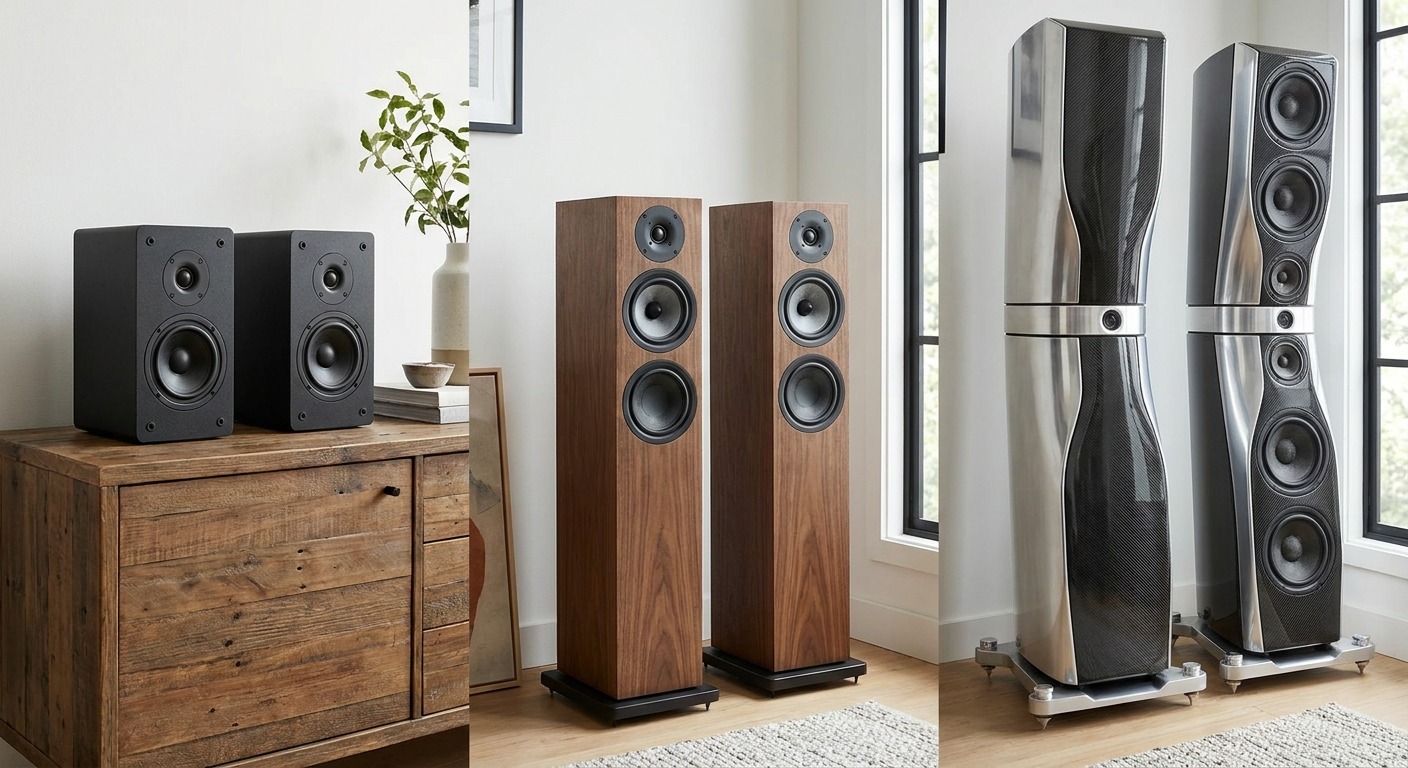
There is a chart that every honest audio enthusiast should tape to their wall. On one axis, money spent. On the other, perceived sound quality. The line climbs steeply at first, then flattens like a prairie highway. That curve explains more about the audio industry than any product review ever written.
The uncomfortable truth is that most of the dramatic improvement in sound quality happens in the first few hundred dollars of spending. After that, you are paying increasingly large sums for increasingly small gains. This is not controversial among engineers. It is only controversial among people who sell expensive equipment.
The First Jump: Budget to Mid-Range
The single biggest leap in audio quality most people will ever experience is going from a $50 bluetooth speaker or cheap computer speakers to a proper pair of bookshelf speakers in the $200 to $400 range. Something like the PSB Alpha P5, the Elac Debut B5.2, or even the remarkably capable Kanto YU4. At this tier, you suddenly hear bass that has actual texture instead of a muddy thump. Vocals gain body. You start hearing instruments separately instead of in a compressed wall of sound.
This jump is enormous because you are going from drivers that are fundamentally compromised by size and cost to drivers that are at least engineered to reproduce sound with some fidelity. You get real crossover networks. You get cabinets with some thought put into resonance management. The difference is not subtle. Anyone can hear it, trained ear or not.
If you understand how speakers actually work at a basic level, the reason for this jump makes intuitive sense. A proper woofer with a decent cone material and suspension simply moves air more accurately than a two-inch full-range driver crammed into a plastic shell.
The Second Jump: Mid-Range to Serious
Going from $300 speakers to something in the $600 to $1,200 range is still clearly worthwhile, but the gains are smaller. You tend to get better cabinet construction, which means less colouration. Better crossover components. Higher quality drivers with tighter tolerances. The result is improved detail retrieval, more controlled bass, and a wider soundstage.
At this level, speakers like the KEF LS50, the Paradigm Founder 40B, or the Wharfedale Linton start showing you what careful engineering sounds like. The midrange clears up. There is less grain in the treble. The bass tightens and extends. These are real improvements that most listeners can identify in a blind test.
But notice the pattern. You spent three to four times more money, and while the sound is meaningfully better, it is not three to four times better. The room you are listening in likely introduces more colouration than the difference between these speakers and the budget pair. That matters, and it is worth considering how your room affects sound before throwing money at better drivers.
The Third Jump: Where Things Get Questionable
Now we enter the territory where the audio industry makes its real money and where honesty gets scarce. Moving from $1,500 speakers to $5,000 speakers typically buys you refinement. Slightly smoother treble. Perhaps more convincing imaging. A bit more bass extension or authority. Cabinet finishes become gorgeous. Build quality feels premium.
Are these differences real? Often yes, if you are listening carefully in a treated room with good upstream electronics. Are they worth three times the price? That is a personal value judgment, but the honest answer for most listeners is probably not. The differences exist on a scale that requires focused attention to appreciate, and they evaporate once you start playing music at a dinner party or while doing dishes.
The honest breakdown of where money matters:
- $50 to $300: Massive, undeniable improvement. Best return on investment in all of audio.
- $300 to $1,200: Clearly worthwhile. Noticeable refinement that rewards attentive listening.
- $1,200 to $3,000: Genuine but small gains. You need a good room and good ears to fully appreciate them.
- $3,000 to $10,000: Marginal improvements plus premium build and aesthetics. Mostly a luxury purchase.
- $10,000 and beyond: Essentially jewelry. The acoustic differences from $5K speakers are negligible for the vast majority of listeners.
The Cable Myth and Its Cousins
No discussion of diminishing returns is complete without addressing the elephant in the room: cables. Speaker cables, interconnects, power cables, and the entire ecosystem of accessories that the high-end audio industry has built around the premise that every link in the chain matters equally.
It does not. A well-constructed copper cable of appropriate gauge will perform identically to a cable costing fifty times more in any properly controlled blind test. This has been demonstrated so many times, with such consistency, that at this point the cable industry survives on faith rather than evidence. The measurements at Audio Science Review have documented this extensively with controlled testing.
The same skepticism applies to many audiophile accessories. Cable risers, equipment isolation platforms made of exotic materials, special outlet covers, and audio-grade fuses all occupy a space where marketing has completely outpaced engineering. Your money is almost always better spent on better speakers, better room treatment, or better source material.
If someone tells you a $500 power cable improved their system's bass response, they are describing a placebo effect. Electricity does not know how much you paid for the wire it travels through.
Where Money Actually Matters
If you want to spend wisely, here is where additional dollars genuinely move the needle. First, speakers. Always speakers. They are the most imperfect link in the audio chain and the component where engineering advances translate most directly into audible improvement. A pair of well-chosen bookshelf speakers or towers matched to your room will outperform an expensive system with poor speakers every single time.
Second, room treatment. This is boring and unattractive, which is why the audio industry barely mentions it, but a few hundred dollars in acoustic panels will do more for your sound than a $2,000 amplifier upgrade. Sound interacts with your room before it reaches your ears, and no piece of electronics can fix a room with terrible reflections and standing waves.
Third, a competent DAC and amplifier. Not an expensive one. A competent one. Modern DACs and amps in the $200 to $500 range measure so well that they are essentially transparent. You can read more about this in our piece on whether you need a separate DAC and amp. Going from a $300 integrated amp to a $3,000 one will produce differences that are, in most cases, inaudible.
The Psychology of Expensive Audio
There is a well-documented psychological phenomenon where spending more money on something makes people perceive it as better. In wine tasting studies, people consistently rate the same wine higher when told it costs more. Audio is no different. When you spend $8,000 on a pair of speakers, you are deeply motivated to hear them as superior. This is not a character flaw. It is how human brains work.
The high-end audio industry leans heavily into this. Unboxing rituals, luxury packaging, heavy machined aluminum cases, glowing vacuum tubes. All of it creates an experience that primes you to hear improvement. And subjectively, you probably do hear improvement. Whether that improvement exists in the acoustic signal or in your expectations is a question most audiophiles prefer not to examine too closely.
None of this means expensive gear is bad or that people who buy it are foolish. If you enjoy the ritual and the aesthetics and the satisfaction of owning finely crafted equipment, those are legitimate reasons to spend money. Just be honest with yourself about what you are buying. You are buying pleasure, not performance. Past a certain price point, they are different things.
A Practical Spending Guide
For someone building a system from scratch who wants genuinely good sound, here is a realistic allocation. Spend roughly 50 to 60 percent of your budget on speakers. Spend 15 to 20 percent on amplification. Spend 10 percent on a DAC or source. Spend the remainder on room treatment, decent cables of appropriate gauge, and proper speaker placement.
That formula will produce better sound than spending the same total budget on one expensive component and neglecting the rest. Audio is a system, and the weakest link sets the ceiling. For most people, that weakest link is the room, followed by the speakers, followed by everything else at a distant third.
Understanding concepts like impedance and sensitivity will help you match components intelligently, which is worth more than spending extra on any single piece of gear. The goal is a balanced system, not a system with one spectacular component surrounded by compromises.
The diminishing returns curve is not a reason to avoid spending money on audio. It is a reason to spend money wisely. The first thousand dollars you invest in sound will transform your listening experience. The next thousand will refine it. After that, you are in the land of personal luxury, and you should enjoy it for what it is rather than pretending the acoustic differences justify the price tag.