Bookshelf Speakers vs Floor-Standing Towers
When bookshelf speakers beat towers, when they do not, and why room size and placement matter more than cabinet height. A practical comparison for home audio.
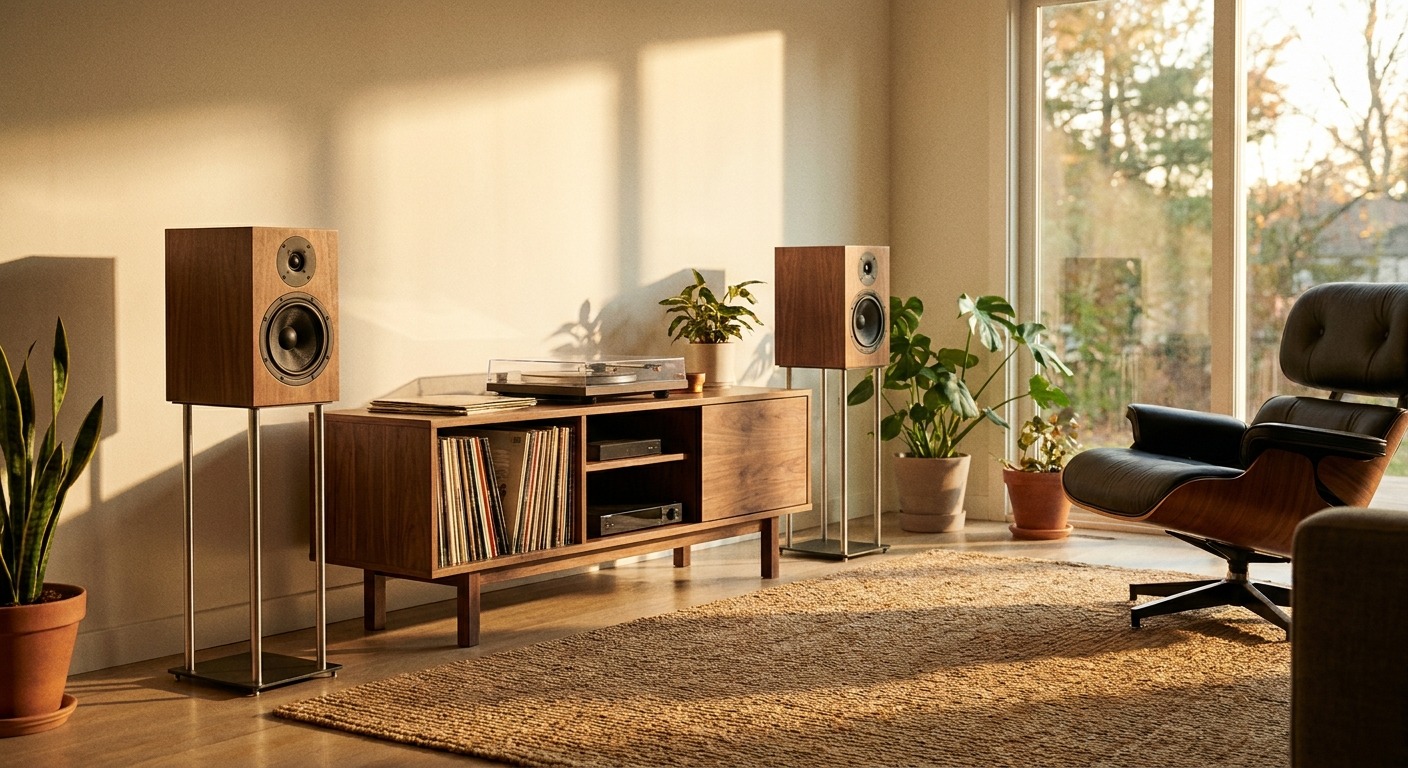
Walk into a hi-fi shop and the floor-standing towers are always front and center. They look impressive. They take up space. They cost more. The implication is clear: bigger speakers are better speakers, and if you are serious about audio, you need towers. This is one of the most persistent myths in home audio, and it costs people money they did not need to spend while steering them away from speakers that would actually sound better in their room.
The relationship between bookshelf speakers and tower speakers is not a hierarchy. It is a set of engineering tradeoffs, and the right choice depends on your room, your listening habits, and whether you are willing to add a subwoofer.
What "Bookshelf" and "Tower" Actually Mean
A bookshelf speaker (also called a standmount) is a compact speaker, typically with one woofer (5 to 7 inches) and one tweeter, in a cabinet that sits on a shelf, desk, or dedicated speaker stand. A floor-standing tower (also called a floorstander) is a tall, narrow cabinet that sits directly on the floor, typically containing two or three woofers, a midrange driver, and a tweeter.
The fundamental difference is low-frequency extension. A larger cabinet with more woofer surface area and greater internal volume can reproduce lower frequencies. A typical bookshelf speaker might have usable response down to 55-65 Hz. A typical tower might reach 35-45 Hz. The tower gets you roughly one octave more of bass — the difference between hearing the fundamental of a kick drum and only hearing its harmonics.
That extra octave comes at a cost: a larger cabinet that interacts more with the room, more drivers that need a more complex crossover to integrate properly, and a higher price for the same quality level. The money that goes into the tower's additional drivers, crossover components, and cabinet material is money that could have gone into better versions of the drivers in a bookshelf.
Key point: At the same price point, a bookshelf speaker will typically have better individual driver quality and crossover design than a tower. The tower spreads its budget across more parts. This means a $500 bookshelf often has better midrange and treble than a $500 tower from the same manufacturer.
The Room Size Factor
In a small room — under about 150 square feet — towers are usually wrong. A room that size will have significant bass buildup from room modes regardless of the speaker, and the extended low-frequency output of a tower will excite those modes further. The result is boomy, uncontrolled bass that muddies the entire sound. Smaller speakers with less bass extension actually sound cleaner in small rooms because they do not excite the worst room resonances.
In a medium room (150-300 square feet), either type can work well, but bookshelf speakers with a subwoofer often outperform towers. The reason: a subwoofer can be positioned independently of the main speakers, which lets you optimize the main speakers for midrange clarity and stereo imaging while placing the sub where it excites the fewest room modes. Towers put the bass where the midrange is, and the best position for midrange imaging is rarely the best position for bass.
In a large room (300+ square feet), towers have a legitimate advantage. The additional driver surface area and lower distortion at high output levels mean towers can fill a large space more effortlessly. A bookshelf speaker in a large room may run out of excursion trying to produce enough volume, especially in the midbass region, where the demands on cone area are highest.
The Myth That Bigger Is Better
What matters is not cabinet size but driver quality, crossover design, and cabinet construction. A well-designed bookshelf with a quality woofer, good tweeter, and carefully tuned crossover will sound better than a poorly designed tower with four mediocre drivers. The number of drivers tells you nothing about how good they are or how well they integrate.
This is especially true in the midrange, where most musical information lives. A bookshelf with a single high-quality 6.5-inch woofer will often have smoother midrange than a tower with two woofers crossed to a dedicated midrange driver. More drivers means more crossover points and more opportunities for phase problems.
The best-measuring speakers under $1,000 on Audio Science Review are overwhelmingly bookshelves. This is not a coincidence. When budget is constrained, concentrating it on fewer, better parts produces better results than spreading it across more, cheaper parts.
Bass Extension: Bookshelf Plus Sub vs. Tower
The most common argument for towers is bass. Towers go lower. This is true, but it is not the whole story. A tower that extends to 38 Hz in an anechoic chamber may not reproduce 38 Hz cleanly in your room. Room gain, boundary reinforcement, and room modes all interact with the speaker's low-frequency output in ways that are unpredictable without measurement.
A bookshelf speaker paired with a quality subwoofer — crossed over at 80 Hz using the receiver's bass management — gives you more flexibility. You place the bookshelves where they image best (typically away from walls, at ear height, forming an equilateral triangle with your listening position). You place the subwoofer where it interacts best with the room's acoustics, which you find through the subwoofer crawl technique described in our room acoustics guide.
The result is better bass and better imaging than a tower can provide, because you are not forcing a single pair of cabinets to do two jobs (bass reproduction and stereo imaging) from positions that compromise one or the other. The bookshelf-plus-sub approach also lets you upgrade the subwoofer independently, which is more cost-effective than replacing a pair of towers when you want deeper bass.
Placement Matters More Than Size
The single most impactful thing you can do for any speaker — bookshelf or tower — is place it correctly. A great speaker in a bad position will sound worse than a mediocre speaker in a good position. This is measurably, provably true, and it is the most overlooked factor in home audio.
Bookshelf speakers belong on stands, at ear height, pulled at least two feet away from the rear wall and at least a foot from side walls. They should be angled slightly inward (toe-in) so the tweeters point toward your head at the listening position. Despite the name, they should not go on a bookshelf, where the shelf boundaries cause diffraction effects and the books on either side create unpredictable reflections.
Towers are less flexible. They sit on the floor, which means the woofers interact heavily with floor reflections. Their height means the tweeter is often above ear level for a seated listener unless you are in a low chair or the tower is designed with a lower tweeter position. They also need to be pulled away from walls, which means they occupy significant floor space by the time they are properly positioned.
In real-world living rooms, where speakers often end up pushed against walls or tucked into corners for aesthetic reasons, a compact bookshelf on a stand is easier to position correctly than a tower. The smaller cabinet causes less boundary interaction, and a stand lets you fine-tune height and distance from walls. This practical advantage is worth more than the extra half-octave of bass extension that a tower provides on paper.
Stands: The Non-Optional Accessory
If you choose bookshelves, budget for stands. They are not optional. A bookshelf on a desk or actual bookshelf will sound worse than the same speaker on a proper stand. The stand gets the tweeter to ear height, reduces surface reflections, and decouples the cabinet from resonant furniture.
Stands should be heavy and rigid — fill the columns with sand or lead shot. Secure the speaker with adhesive putty to prevent sliding. The tweeter should be at or within a couple of inches of ear level when you are seated.
When Towers Win
Towers are the right choice in specific scenarios: large rooms where you do not want a separate subwoofer, or when you need the output capability and power handling of multiple woofers. They also make sense in home theater where the left and right channels need to produce enough output for a wide seating area without straining.
The Practical Decision
For most listeners in most rooms, a quality pair of bookshelf speakers on good stands, with or without a subwoofer, is the better investment than towers at the same total price. You get better per-driver quality, more placement flexibility, easier room integration, and the option to add bass extension later without replacing the main speakers.
If you do choose towers, buy the best you can afford and accept that proper placement will require giving them room to breathe. A tower pushed against a wall is a tower that sounds like it cost half what you paid. For more on getting the most out of whatever speakers you choose, read our guides on room acoustics and what makes speakers sound good. Our resources page links to measurement databases where you can compare specific models before you buy.