What Makes a Speaker Sound Good?
The real factors behind good speaker sound: frequency response, driver quality, cabinet design, and crossover engineering. Why specs do not tell the whole story.
Ask ten people what makes a speaker sound good and you get ten vague answers. "Warm." "Detailed." "Musical." These describe subjective preferences, not engineering qualities. The factors that make a speaker reproduce sound accurately are measurable, well-understood, and rarely discussed in marketing copy.
Here is what actually determines whether a speaker faithfully reproduces what was recorded.
Frequency Response: Flat Is the Goal
The most important single measurement of a speaker is its frequency response — a graph showing how loud the speaker plays at each frequency when fed a constant-level signal. A speaker with flat frequency response reproduces all frequencies at the same level. What goes in comes out. The recording sounds the way the mixing engineer intended.
This seems obvious, but most speakers are not flat. Many consumer speakers are deliberately voiced with a bass bump and a treble sparkle — a "smiley face" frequency response that sounds exciting on first listen but colors everything you play. Acoustic instruments sound wrong, vocals get unnatural emphasis, and after extended listening, the exaggerated frequencies become fatiguing.
Flat does not mean boring. A flat speaker reproduces the dynamics and tonal balance of the recording without adding its own character. The speaker gets out of the way and lets the music speak. This is what studio monitors aim for, and it is what your home speakers should aim for too.
Key point: When looking at frequency response, pay attention to the scale. A graph with +/- 3 dB variation from 50 Hz to 20 kHz is excellent. A graph with +/- 10 dB variation over the same range is terrible, even if both graphs are labeled "50 Hz - 20 kHz." The tolerance matters as much as the range.
Most manufacturers give you a frequency range like "45 Hz - 22 kHz" without specifying the tolerance. A speaker could be 15 dB down at 45 Hz and still technically "reproduce" that frequency. Look for actual measurement graphs, or consult Audio Science Review for standardized independent measurements.
On-Axis vs. Off-Axis: The Whole Picture
Frequency response is usually measured on-axis, but you do not listen exclusively on-axis. Sound bounces off walls, ceiling, and floor. In a typical room, most of what you hear is reflected sound. This means off-axis response matters enormously.
The best speakers have smooth, gradually narrowing dispersion as frequency increases — the off-axis response should mirror the on-axis shape, just quieter. This "constant directivity" is a hallmark of well-engineered speakers. Products with erratic off-axis behavior produce unpleasant reflections that create a confused, fatiguing sound.
Driver Quality: What Separates Cheap from Good
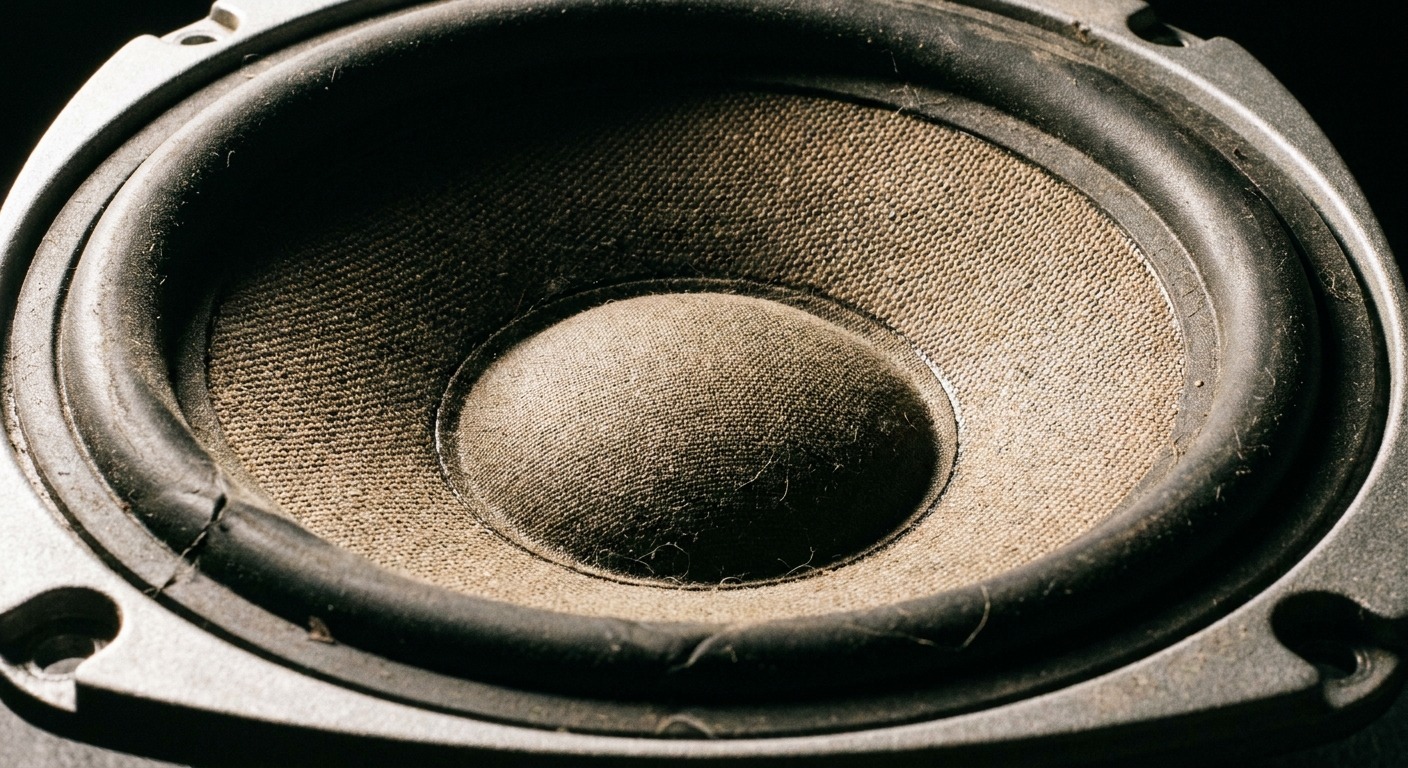
A speaker driver is an electromechanical device: a voice coil in a magnetic gap, attached to a cone, suspended by a spider and surround. The quality of each component matters, and the tolerances in manufacturing matter even more.
The cone should be stiff enough to move as a piston across its operating range and light enough to respond quickly to the signal. Common materials include paper, polypropylene, aluminum, and woven composites like Kevlar. No single material is universally best — each has tradeoffs in stiffness, weight, and damping. What matters is that the cone behaves predictably, without resonance modes that show up as peaks in the frequency response.
The surround (the flexible ring connecting the cone to the frame) affects excursion capability and linearity. Rubber surrounds are generally more durable and linear than foam. Cheap surrounds restrict movement or have inconsistent compliance that distorts at higher excursion levels.
The motor system (magnet and voice coil) determines how precisely the cone follows the electrical signal. A larger magnet means more control over cone motion. Longer voice coils provide more force and better linearity, especially at large excursions. Budget speakers use smaller magnets and shorter coils, which means they distort earlier as volume increases.
The frame (basket) should be rigid enough not to flex under mechanical stress. Cast aluminum frames hold tight tolerances. Stamped steel frames can flex, changing the voice coil's alignment in the magnetic gap — a misalignment measured in fractions of a millimeter that causes audible distortion.
The difference between a $15 driver and a $60 driver of the same size is not subtle. It is visible in the build quality, measurable in the distortion figures, and audible from the first note. Driver quality is the foundation that everything else depends on.
Cabinet Design: More Than a Box
The cabinet is not just something to mount the drivers in. It is an acoustic device that profoundly affects the speaker's sound. A poorly designed cabinet adds resonances, colors the midrange, and can negate the performance of excellent drivers.
Cabinet walls vibrate. When the woofer moves, energy that does not go into moving air goes into the cabinet structure. Thin, undamped panels radiate sound that blurs the direct output from the drivers. The solution is mass, bracing, and damping — thick walls (3/4-inch MDF minimum), internal bracing, and damping material on interior surfaces.
Cabinet volume and port tuning must match the specific drivers used. For ported designs, the port dimensions must be calculated from the driver's Thiele/Small parameters. Getting this wrong produces boomy, one-note bass regardless of driver quality. Internal standing waves are addressed with absorptive filling — polyester fiber or acoustic foam — that damps reflections without over-damping the air volume.
Crossover Design: The Hidden Performance Factor
In any multi-driver speaker, a crossover network divides the incoming signal so that each driver only receives the frequencies it is designed to reproduce. The woofer gets the lows and mids, the tweeter gets the highs, and any midrange driver gets the frequencies in between. The crossover is the part of the speaker that most affects the final sound and is least visible to the buyer.
A good crossover divides the frequency spectrum with appropriate slope steepness (typically 12-24 dB per octave), compensates for each driver's impedance characteristics, and aligns the acoustic output so drivers are in phase at the crossover frequency. It may also include baffle step compensation for the transition from omnidirectional to directional radiation.
The quality of crossover components matters. Air-core inductors have lower distortion than iron-core types that saturate at high power. Film capacitors hold tight tolerances and stay stable, while electrolytics are cheap, loose, and drift over time. Two speakers using identical drivers but different crossovers can sound dramatically different. The crossover determines tonal balance, driver integration, off-axis response, and power handling. It is the most important part of a multi-way speaker.
Why Specs Do Not Tell the Whole Story
The specs most manufacturers publish are either incomplete or misleading. Frequency response without tolerance is meaningless. Sensitivity tells you about efficiency, not quality. Power handling tells you what the speaker survives, not how it sounds. Impedance varies wildly with frequency despite being listed as a single number.
The specs that matter — detailed on and off-axis response, distortion vs. frequency and level, impedance curves, waterfall plots — are the specs most manufacturers do not publish. Independent measurement sites are invaluable for this reason.
Key point: Do not buy speakers based on manufacturer specs alone. Look for independent measurements. If measurements do not exist for a speaker you are considering, that itself is useful information — it means nobody with measurement equipment thought it was worth reviewing.
What to Listen For
Measurements are necessary but not sufficient. You also need to listen, and listening critically is a skill that improves with practice. When auditioning speakers, focus on these qualities:
- Tonal balance: Play familiar recordings and listen for whether the balance sounds right. If one frequency range dominates, the speaker is voiced rather than neutral.
- Midrange clarity: Vocals should sound natural, neither nasal nor chesty. Male and female voices should have proper weight without being pushed forward or recessed.
- Imaging: With proper placement, a good speaker disappears. You should hear instruments in space between the speakers, not coming from two boxes.
- Dynamic range: The speaker should handle quiet and loud passages without strain. Compression at moderate volumes indicates driver or amplification limitations.
- Bass quality: Can you hear distinct bass notes, or does everything below 100 Hz blur into a thump? Tight, articulate bass is harder to achieve than loud bass.
Listen at the volumes you actually use, not showroom levels. A speaker that sounds impressive at 90 dB may sound lifeless at 70 dB, where most home listening happens. And listen for more than five minutes — first impressions are unreliable, and coloration that was initially exciting becomes fatiguing.
Putting It All Together
A good speaker combines flat frequency response, smooth off-axis behavior, quality drivers, a well-braced cabinet, and a carefully designed crossover. The weakest link determines the ceiling, which is why throwing money at one aspect while neglecting others produces disappointing results.
The good news is that genuinely excellent speakers exist at modest prices. The gap between a $200 speaker and a $2,000 speaker has never been smaller, thanks to better driver manufacturing, computer-optimized crossover design, and independent measurement culture that holds manufacturers accountable. For help choosing between form factors, read our bookshelf vs. tower comparison. For optimizing whatever speakers you choose, our room acoustics guide will do more for your sound than any gear upgrade. And for the deeper technical foundations, our guide to crossover considerations in car speakers covers principles that apply to all multi-way speaker systems.