How Speakers Actually Work
A clear explanation of speaker driver technology: voice coils, magnets, cones, and suspension. How electromagnetic force becomes the sound you hear.
A speaker is a machine that converts electricity into air movement. That is it. Every speaker ever built, from a tin-can telephone to a $50,000 electrostatic panel, does fundamentally the same thing: takes an electrical signal and uses it to push and pull air in patterns that your ears interpret as sound. The specifics of how this happens are elegant, simple in principle, and fiendishly difficult to execute well.
The Core Components
The overwhelming majority of speakers in the world use the dynamic driver design, which has remained essentially unchanged since the 1920s. It consists of a handful of components working together in a system that is mechanically straightforward but acoustically complex.
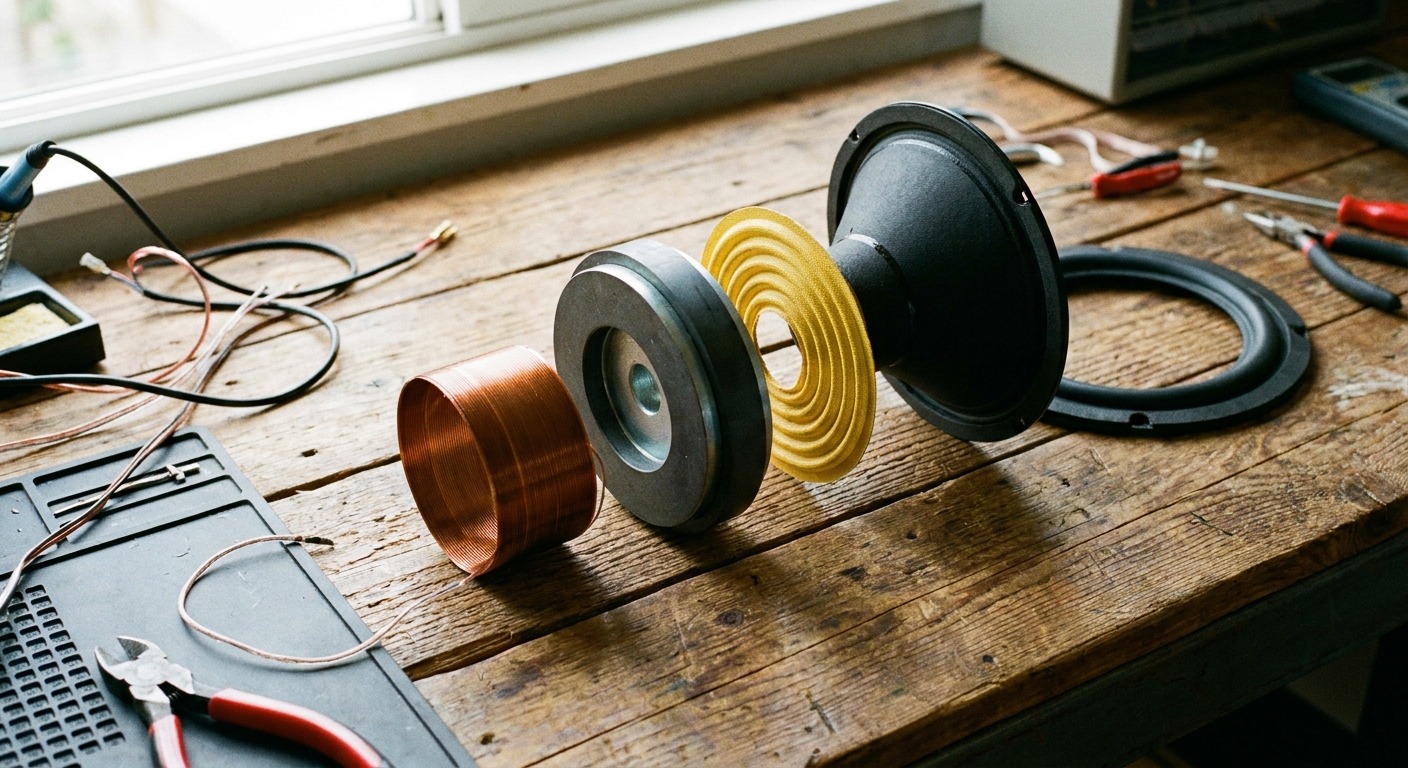
The magnet provides a permanent magnetic field. In most speakers, this is a ring of ferrite (ceramic) or neodymium mounted at the back of the driver. It does not move. Its job is to create a strong, stable magnetic field in a narrow gap where the voice coil sits.
The voice coil is a cylinder of wire wound around a former (a lightweight tube) that sits inside that magnetic gap. When electrical current flows through the wire, it creates its own magnetic field. This field interacts with the permanent magnet's field, producing a force that pushes the coil forward or pulls it backward, depending on the direction of the current. This is basic electromagnetism: current-carrying conductor in a magnetic field experiences a force.
The cone (or diaphragm) is attached to the voice coil. When the coil moves, the cone moves with it. The cone is the part that actually displaces air. It needs to be light enough to move quickly, stiff enough to move as a single unit without flexing, and well-damped enough not to ring or resonate at particular frequencies. Cone materials range from paper (still excellent and widely used) to polypropylene, kevlar, aluminum, beryllium, and various composites.
The suspension has two parts. The surround is the flexible ring connecting the outer edge of the cone to the frame (basket). The spider is a corrugated disc connecting the voice coil former to the frame near the magnet. Together, they keep the voice coil centred in the magnetic gap while allowing it to move freely back and forth. They also provide a restoring force that returns the cone to its rest position, much like a spring.
The signal path through a dynamic speaker:
- Electrical audio signal arrives from the amplifier
- Current flows through the voice coil, creating a varying magnetic field
- Voice coil's field interacts with permanent magnet's field, producing mechanical force
- Voice coil and attached cone move forward and backward, following the signal
- Cone movement displaces air, creating pressure waves
- Pressure waves travel to your ears as sound
Electromagnetic Force to Mechanical Motion
The voice coil and magnet assembly is really just a linear electric motor. The audio signal coming from your amplifier is an alternating current that represents the original sound wave. When the current swings positive, the coil pushes the cone outward. When it swings negative, the coil pulls the cone inward. The cone traces the shape of the electrical waveform in physical space, and because air is in contact with the cone, it traces that same shape as pressure variations.
This sounds simple, and conceptually it is. In practice, it is extraordinarily difficult to execute with precision. The cone has mass, so it resists changes in direction. The suspension has compliance and damping characteristics that vary with temperature and age. The voice coil heats up during use, changing its resistance. All of these factors introduce non-linearities, which is a polite way of saying distortion. The engineering challenge is managing these non-linearities, and sites like Audio Science Review publish spinorama measurements that reveal how well various speakers manage these compromises.
Why Different Drivers for Different Frequencies
A single driver cannot reproduce the entire audible frequency range (roughly 20 Hz to 20,000 Hz) well. This is a physics problem, not an engineering failure. Low frequencies require moving a large volume of air, which means a large cone with significant excursion (back-and-forth travel). High frequencies require the cone to change direction thousands of times per second, which means it needs to be very light and very small.
These requirements are contradictory. A large, heavy woofer cone simply cannot accelerate fast enough to reproduce a 15,000 Hz cymbal shimmer. A tiny, light tweeter dome cannot move enough air to produce a 40 Hz bass note at any useful volume. The solution, used in virtually every serious speaker system, is to split the frequency range among specialized drivers.
Woofers handle the low frequencies, typically from the low end up to somewhere between 500 Hz and 2,000 Hz. They have large cones (usually 5 to 12 inches in home speakers, larger in subwoofers) with heavy voice coils and long excursion capability. Their cone materials prioritize stiffness and damping over light weight.
Tweeters handle the high frequencies, typically from around 2,000 Hz up to the limit of human hearing and sometimes beyond. The most common type is the dome tweeter, a small (usually 1-inch) dome made of silk, aluminum, beryllium, or other materials. Some designs use ribbon or planar magnetic tweeters for their excellent transient response.
Midrange drivers appear in three-way systems and handle the range between woofer and tweeter, roughly 500 Hz to 3,000 Hz. This covers most vocals and many instruments. Getting this range right is arguably the most important factor in how natural a speaker sounds. A crossover network splits the signal between drivers, and three-way designs add a dedicated midrange for smoother coverage.
Enclosures and Their Role
A driver mounted in open air sounds thin and weak because the sound from the back of the cone cancels the sound from the front at low frequencies. The wavelengths are long enough that they wrap around the driver and interfere destructively. This is why raw drivers need enclosures.
The simplest enclosure is a sealed box. It traps the rear radiation entirely, preventing cancellation. The trapped air acts as a spring, adding to the suspension's restoring force. Sealed boxes produce clean, well-controlled bass that rolls off gradually below the system's resonant frequency. They are forgiving of placement and room interactions.
Ported (bass reflex) enclosures add a tuned port or vent that allows some rear radiation to emerge in phase with the front radiation at a specific frequency. This extends bass output and improves efficiency near the port tuning frequency, but bass rolls off more steeply below that point. The same sealed versus ported trade-offs apply whether you are building a subwoofer box for a car or choosing home speakers.
The enclosure itself must be rigid and well-damped to avoid adding its own resonances to the sound. Knock on a cheap speaker cabinet and you will hear it ring. Knock on a well-built one and you hear a dull thud. That difference in cabinet behaviour translates directly to a difference in sound quality, particularly in the midrange where cabinet colouration is most audible.
Learning More and Sharing Knowledge
Understanding how speakers work opens the door to making better purchasing decisions, appreciating good engineering, and even building your own. The DIY speaker community is one of the most welcoming corners of the audio hobby. Parts suppliers like Parts Express sell individual drivers, crossover components, and cabinet materials, and the community forums are full of people happy to help newcomers learn.
Public libraries, community colleges, and makerspaces across Canada offer resources for people who want to go deeper into electronics and acoustics. Town libraries in places like Kingston, Peterborough, and Belleville often stock books on audio engineering that would cost a fortune to buy. Broader local community resources like petawawa.com and similar municipal hubs in communities across the Ottawa Valley, Muskoka, and Georgian Bay regions often list workshops, maker events, and educational programs where hands-on learning happens naturally. The knowledge is out there if you look for it.
Acoustic Output and What You Hear
The final step in the chain is the conversion of cone movement into sound waves that reach your ears. This is where things get complicated, because the speaker is not operating in a vacuum. It is operating in your room, and the room has an enormous influence on what you actually hear.
Sound radiates from the cone in a pattern that depends on the frequency and the size of the driver. At low frequencies, the pattern is essentially omnidirectional: bass goes everywhere. At higher frequencies, the pattern narrows, focusing the sound more directly in front of the speaker. The sound that reaches your ears is a combination of the direct sound and reflected sound from walls, ceiling, floor, and furniture. In most rooms, reflected sound dominates, which is why room acoustics matter enormously and why speaker placement has such a large effect on what you hear.
Why This Knowledge Matters
You do not need to understand electromagnetic theory to enjoy music. But understanding the basics makes you a better consumer. You see through marketing language. You understand why a tiny bluetooth speaker physically cannot produce deep bass, no matter what the advertising claims. It also helps you understand related concepts like impedance and sensitivity, which determine how much power your speakers need. These are direct consequences of the physical properties described above.
Every speaker is a compromise. The laws of physics make a perfect speaker impossible. But understanding those compromises lets you choose the ones that matter least to you and your listening environment, and that is the foundation of putting together a system that actually sounds good.