Car Audio Basics: What You Actually Need
A practical guide to car audio upgrades. Head units, speakers, amplifiers, and subwoofers — what actually matters and what is just marketing noise.
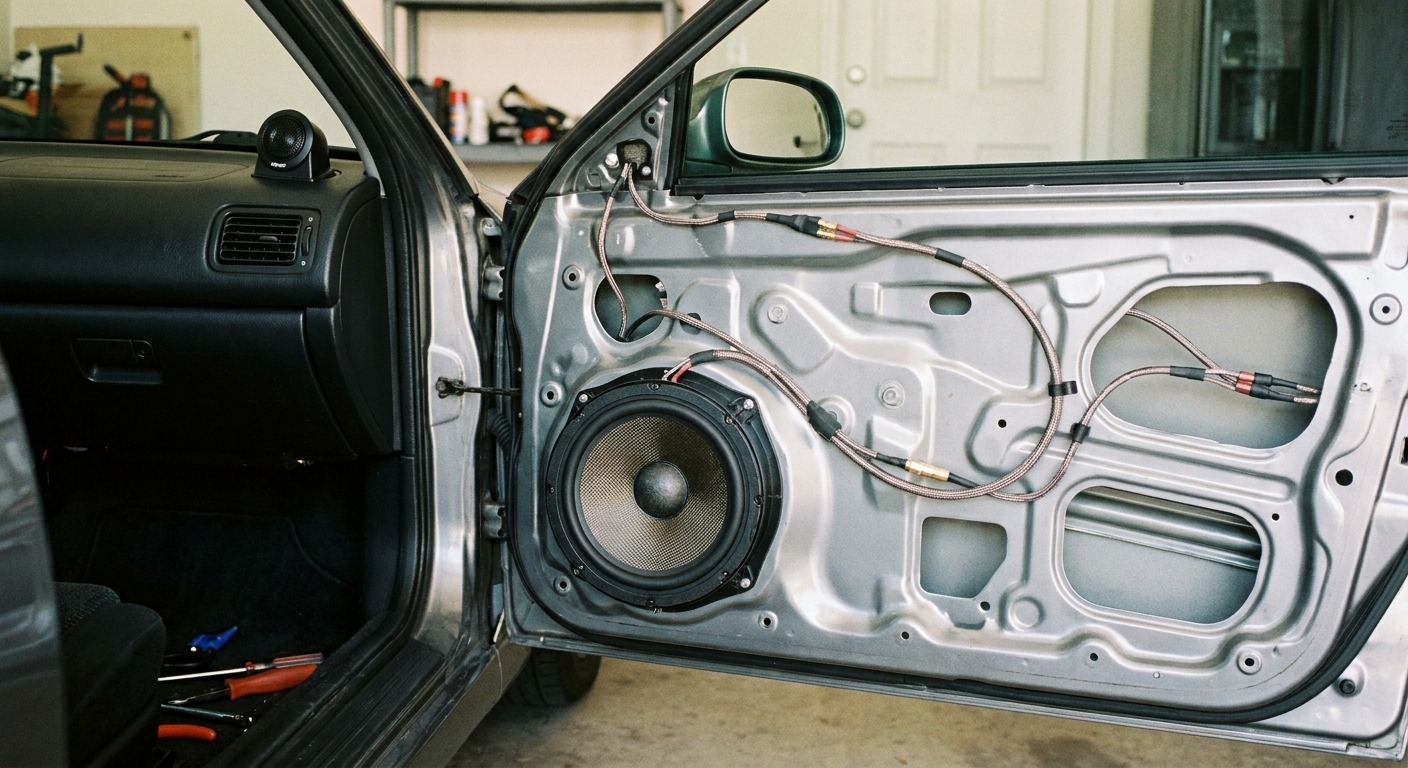
Walk into a car audio shop and you will be told you need a new head unit, four new speakers, a four-channel amplifier, a subwoofer, a mono amp for the sub, a capacitor, new wiring, and sound deadening for every panel in the vehicle. The bill will be somewhere north of two thousand dollars. Most of it is unnecessary for someone who just wants their music to sound decent on the drive to work.
Here is what actually matters in a car audio system, what order to upgrade it in, and where the marketing claims diverge from acoustic reality.
The Signal Chain: Understanding What Does What
A car audio system is a chain. The source (your phone, a head unit, streaming) sends a signal to processing (EQ, crossovers, time alignment), which sends it to amplification, which sends it to speakers. Every link matters, but some links matter a lot more than others.
The source is almost never the bottleneck. If you are streaming from your phone via Bluetooth, the quality limitation is the Bluetooth codec, and even that is good enough for a car environment. The noise floor in a moving vehicle — tire noise, wind, engine — is high enough that the difference between a lossless file and a 256kbps AAC stream is inaudible. Anyone who tells you otherwise has not done a blind test in a moving car.
Key point: In a car at highway speed, ambient noise is typically 65-75 dB. This masks low-level detail that you might hear in a quiet room. Do not spend money chasing source quality in a vehicle. Spend it on speakers and amplification.
The head unit matters mainly as a control interface and for its preamp outputs. If your factory head unit has preamp outputs (most do not), you can work with it. If it does not, an aftermarket unit with clean preamp voltage (4V or higher) gives your amplifier a better signal to work with. But the head unit itself is not making the sound — it is just passing the signal along.
Factory Speakers: Why They Sound Bad
Factory speakers are not terrible because car manufacturers are incompetent. They are terrible because they are cheap. The speakers in most vehicles cost the manufacturer between three and eight dollars each. They use thin stamped-steel frames, paper or polypropylene cones with minimal excursion capability, and ferrite magnets sized for cost rather than performance. They are designed to reproduce voice and midrange frequencies at moderate volumes without distorting badly enough to generate warranty claims.
The factory amplification is similarly constrained. Most factory head units put out 15-22 watts RMS per channel, despite whatever the faceplate says about "50W x 4." That number is peak power measured at 10% THD, which is grossly distorted. The actual clean power is much lower.
A car manufacturer is not going to spend $400 on audio when they can spend $40 and most buyers will never notice. The "premium" audio packages from brands you recognize are better, but they are still built to a price point that would make a home audio listener wince.
What to Upgrade First: Speakers
If you are going to upgrade one thing, upgrade the front speakers. They do most of the work in a car audio system, and the improvement from factory to aftermarket is dramatic. A decent set of component or coaxial speakers in the $80-150 range will sound noticeably better than factory, even running off the factory head unit power.
You want speakers with a sensitivity rating of at least 88 dB, which means they produce usable volume from low power. Polypropylene or treated paper cones hold up well in the temperature and humidity extremes of a car environment. Avoid speakers with flashy cosmetics and vague specs — if the manufacturer does not publish a frequency response graph, they are hiding something.
The install matters as much as the speaker. Factory locations often have poor mounting depth and no sealed enclosure behind the speaker. If you are willing to fabricate adapters and seal the door properly, the results improve significantly. Sound deadening behind the speaker reduces rattling and gives it a more controlled environment.
Amplification: When and Why
Adding an external amplifier is the second-most impactful upgrade, but only after you have decent speakers to drive. An amplifier does two things: it provides more power (louder, cleaner output at high volume) and it provides a cleaner signal (lower noise floor, less distortion at any volume).
You do not need enormous power. A quality four-channel amp putting out 50-75 watts RMS per channel is enough for most people. This gives you roughly four times the clean power of a factory head unit, which translates to noticeably louder output without distortion and significantly better dynamic range.
The critical part that most people get wrong is gain setting. The gain control on an amplifier is not a volume knob. It matches the input sensitivity of the amp to the output voltage of the head unit. Set it wrong and you introduce clipping, which sounds harsh and can destroy speakers. Set it right and you get clean, controlled power across the volume range.
More power does not mean more volume in the way most people think. Doubling your amplifier power only adds about 3 dB of output — barely noticeable. What more power gives you is headroom: the ability to play louder without distortion. That is where the improvement comes from.
Subwoofers: Necessary or Not?
A subwoofer is not strictly necessary, but it is the most efficient way to add low-frequency extension to a car audio system. Door-mounted speakers, even good ones, cannot reproduce deep bass effectively. They do not have enough cone area or excursion, and a car door is not a proper enclosure.
A single 10-inch or 12-inch subwoofer in a properly built enclosure, powered by a modest mono amplifier (300-500 watts RMS), will transform the low end of your system. The key word is "properly built." A prefab box from a discount store is almost certainly the wrong volume and wrong tuning frequency for the specific driver you are using. Building or commissioning a custom box based on the manufacturer's recommended enclosure specs is the single most important factor in subwoofer performance.
If you do not want to give up trunk space, consider a compact sealed enclosure. It will not play as loud as a ported box, but it will be tighter, more accurate, and take up less room. For most listeners who want bass they can feel without building an SPL competition vehicle, this is the right approach.
Sound Deadening: The Overlooked Upgrade
A car is a terrible acoustic environment. Thin sheet metal vibrates, plastic panels rattle, and road noise bleeds in from every direction. Sound deadening — butyl rubber sheets applied to door skins, floor pans, and trunk panels — addresses this directly. It is messy to install and not glamorous, but the improvement in midrange clarity and bass definition is real and measurable.
You do not need to cover every square inch of the vehicle. Focus on the doors (where your front speakers live) and the trunk (where your subwoofer lives). Two square feet of deadening behind each front speaker and around the subwoofer enclosure makes a meaningful difference. Going beyond that gives diminishing returns unless you are chasing competition-level sound quality.
What You Do Not Need
A few things the car audio industry will try to sell you that you should be skeptical about:
- Capacitors ("stiffening caps"). If your lights dim when the bass hits, the answer is a better alternator or a second battery, not a capacitor. A cap does not address the underlying electrical problem.
- Monster gauge wire for short runs. For a standard install, 16-gauge speaker wire is fine for runs under 15 feet. Oxygen-free, silver-plated, cryogenically treated wire is marketing. Copper is copper.
- Powered subwoofers that mount under a seat. Convenient but acoustically compromised. The drivers and enclosures are too small. They add a slight thump to the midbass but do not produce real sub-bass.
- Upgrading every speaker location. Rear speakers are often better left at factory level or disconnected. The front stage does the work and the rears just add ambience that can smear imaging.
The Practical Upgrade Path
If you are starting from factory everything and want to improve your sound on a budget, here is the order that gives you the most improvement per dollar:
- Replace front speakers with quality aftermarket components or coaxials ($80-150).
- Add sound deadening to the front doors ($40-60 in material).
- Add an aftermarket head unit with preamp outputs if your factory unit lacks them ($100-200).
- Add a four-channel amplifier for the front speakers ($150-250).
- Add a subwoofer in a custom enclosure with a mono amp ($200-400 total).
Each step builds on the previous one. You can stop at any point and have a system that sounds substantially better than factory.
For more on choosing between speaker types, read our component vs coaxial comparison. If you are ready to think about how speakers work at a fundamental level, our guide to what makes a speaker sound good covers the principles that apply everywhere, not just in cars.