Sealed vs Ported Subwoofer Boxes
The acoustic differences between sealed and ported subwoofer enclosures. Box volume, tuning frequency, transient response, and why prefab boxes are almost always wrong.
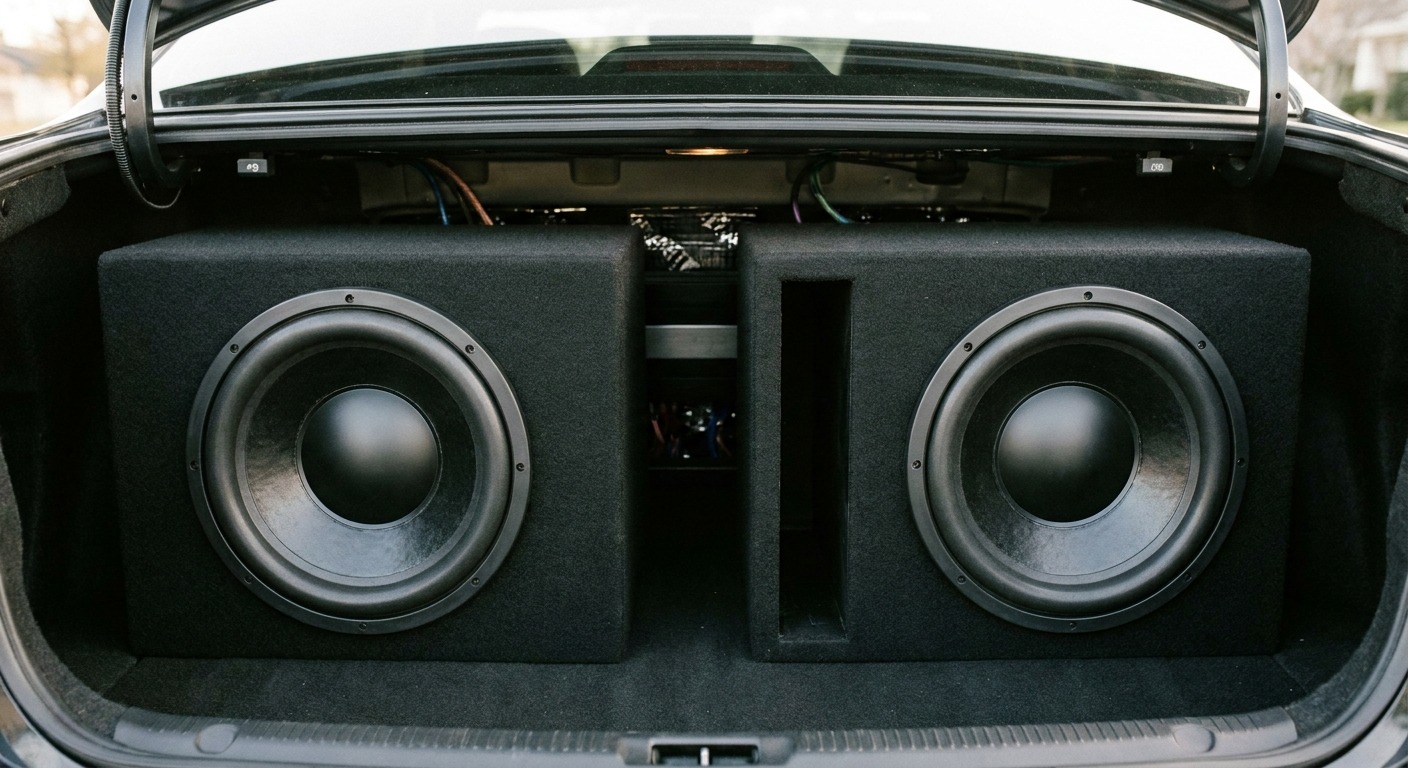
The enclosure is the most important part of a subwoofer system. Not the driver, not the amplifier — the box. A good sub in the wrong box will sound terrible. A mediocre sub in a properly designed enclosure will sound surprisingly competent. Yet enclosure design is the part that most car audio buyers spend the least time thinking about, and the car audio industry is happy to sell you a prefab box that was designed by nobody for no specific driver.
The two fundamental enclosure types are sealed and ported. They are not different grades of quality — they are different engineering approaches that produce different acoustic results. Understanding what each one does, and why, is the foundation of building a subwoofer system that actually sounds the way you want.
How a Sealed Enclosure Works
A sealed enclosure (also called acoustic suspension) is exactly what it sounds like: a completely airtight box with a subwoofer driver mounted in one wall. When the cone moves outward, it compresses the air in the room (or car cabin). When it moves inward, it compresses the air trapped inside the box. That trapped air acts as a spring, providing a restoring force that controls the cone's motion.
The sealed box raises the driver's resonant frequency (Fs) to a new, higher system resonant frequency (Fc). Below this system resonance, the output rolls off at 12 dB per octave — a gradual, well-behaved slope. The result is bass that extends smoothly down to a point and then fades away without any sharp peaks or dips.
The acoustic character of a sealed enclosure is often described as "tight" or "accurate." What this actually means in measurable terms is that the transient response is excellent. When a kick drum hits, the cone moves forward and comes back quickly because the air spring is always pushing it toward its resting position. There is minimal overshoot and minimal ringing. The bass starts and stops when the signal tells it to.
Key point: A sealed box trades maximum output for transient accuracy and simplicity. If you want bass that is precise and controlled — where you can hear individual bass notes clearly rather than just feeling a rumble — sealed is the right starting point.
How a Ported Enclosure Works
A ported enclosure (also called bass reflex) adds a tuned opening — a port — to the sealed box. The port is a tube or slot of specific length and diameter that allows air inside the enclosure to communicate with the air outside. At the tuning frequency of the port, the air in the tube resonates, and this resonance reinforces the driver's output. The port essentially becomes a second sound source that adds output in a narrow frequency band.
Around the tuning frequency, the port takes over bass production and the cone moves less, reducing distortion and increasing power handling. Below the tuning frequency, the port stops loading the cone, and output drops off at 24 dB per octave — much steeper than a sealed box's 12 dB rolloff. The cone is essentially unloaded below tuning, which can allow damaging over-excursion if you feed it subsonic content at high power.
Tuning Frequency: Why It Matters
The tuning frequency of a ported enclosure is the most critical design parameter. It determines where the port provides its boost and where the system's output rolls off. A box tuned to 35 Hz will have its peak reinforcement around 35 Hz and will drop off steeply below that. A box tuned to 28 Hz will extend lower but will have slightly less peak output.
The tuning frequency is set by the port's length and cross-sectional area in combination with the box volume. Change any of these three variables and the tuning frequency changes. This is why prefab boxes are problematic — they are built to a fixed set of dimensions that define a fixed tuning frequency, and that tuning frequency is almost certainly not optimal for the specific driver you are putting in them.
Every subwoofer has Thiele/Small parameters that define its mechanical and electrical behavior. Vas (equivalent air compliance), Qts (total Q factor), and Fs (free-air resonance) determine the optimal box volume and tuning frequency. A driver with a Vas of 30 liters needs a very different box than one with a Vas of 80 liters.
If a subwoofer manufacturer publishes recommended enclosure specs, use them. They have modeled and measured the driver in various enclosures and are telling you what works. If you ignore their recommendations and put the driver in a random prefab box, you are paying for engineering that you are choosing not to use.
The Prefab Box Problem
Prefab enclosures are built to standard dimensions — typically 1.0 cubic feet for a 10-inch and 1.5 cubic feet for a 12-inch. These round numbers may or may not suit any given driver. The ported versions are usually tuned at 35-40 Hz, and the ports are often too narrow, causing turbulence noise — that chuffing sound from badly designed boxes.
Building a custom enclosure from MDF is not difficult with basic tools. Cut the panels, glue and screw them, seal every joint, cut the driver hole. Materials cost $20-40, and most lumber yards will cut MDF panels to your dimensions for a small fee.
Sealed vs. Ported: The Listening Difference
Put a sealed and a ported enclosure side by side, using the same driver and the same amplifier power, and listen. The ported box will be louder — typically 3-6 dB more output around its tuning frequency. That is a significant difference. In a car, where you feel bass as much as hear it, the ported box will hit harder and be more physically impactful.
The sealed box will have better definition. Play a song with complex bass — a walking jazz bass line, a funk track with rapid sixteenth notes in the bass — and the sealed box will articulate each note more clearly. The ported box may smear rapid notes together because the port's resonance continues to ring slightly after the signal stops. This is the transient response difference that people describe as "tight" vs. "boomy."
Neither is objectively better. If you listen to electronic music or hip-hop where bass impact matters, ported delivers. If you listen to acoustic music or rock where bass definition matters, sealed serves better. Most people should consider what they prioritize — impact or accuracy — and choose accordingly.
Other Enclosure Types
Sealed and ported cover the vast majority of car audio subwoofer applications, but a few other designs exist:
- Bandpass enclosures seal the driver inside a dual-chamber box where the output comes only through a port. They can be very efficient in a narrow frequency band but sound terrible outside that band. Difficult to design correctly and unforgiving of errors. Not recommended unless you know exactly what you are doing.
- Transmission line enclosures use a long, often folded, internal pathway to load the driver. Theoretically elegant but enormous for car audio use. You will occasionally see them in home subwoofers.
- Infinite baffle mounts the driver in a large surface (like the rear deck or a trunk wall) without a traditional box, using the trunk as the rear volume. Can sound excellent with the right driver and implementation, and saves trunk space. Less common because it requires commitment — you are cutting a hole in your car.
Practical Guidelines for Choosing
Choose sealed if: you have limited space, you value bass accuracy over maximum output, you listen to music with complex bass content, you want the simplest possible build, or you are not confident in your ability to design a port correctly.
Choose ported if: you want maximum output for the power available, you have enough space for the typically larger enclosure, you listen to music where deep bass impact is the priority, and you are willing to build to the correct specifications for your driver.
Regardless of which type you choose, get the volume right. Use the driver manufacturer's specifications or a modeling program like WinISD (free) to calculate the optimal enclosure volume and, for ported boxes, the tuning frequency and port dimensions. This is not guesswork — it is straightforward math based on published parameters, and getting it right is the difference between a subwoofer that sounds correct and one that sounds wrong.
Key point: The enclosure and the driver are a system. Neither works correctly without the other being right. A $300 driver in a $25 prefab box will be outperformed by a $100 driver in a properly designed custom enclosure. Spend the time to get the box right.
Once your subwoofer enclosure is sorted, the next piece is feeding it the right power. Read our amplifier matching and gain setting guide to understand how to pair your amp to the sub without clipping or underpowering. And if you are still deciding on your overall system architecture, start with our car audio basics overview to understand how the subwoofer fits into the bigger picture. For the fundamentals of what makes any speaker sound good, that guide covers principles that apply to subwoofers too.