Component vs Coaxial Speakers: The Real Difference
Understanding the practical differences between component and coaxial car speakers. When separate tweeters and woofers matter, when they do not, and what to consider for your install.
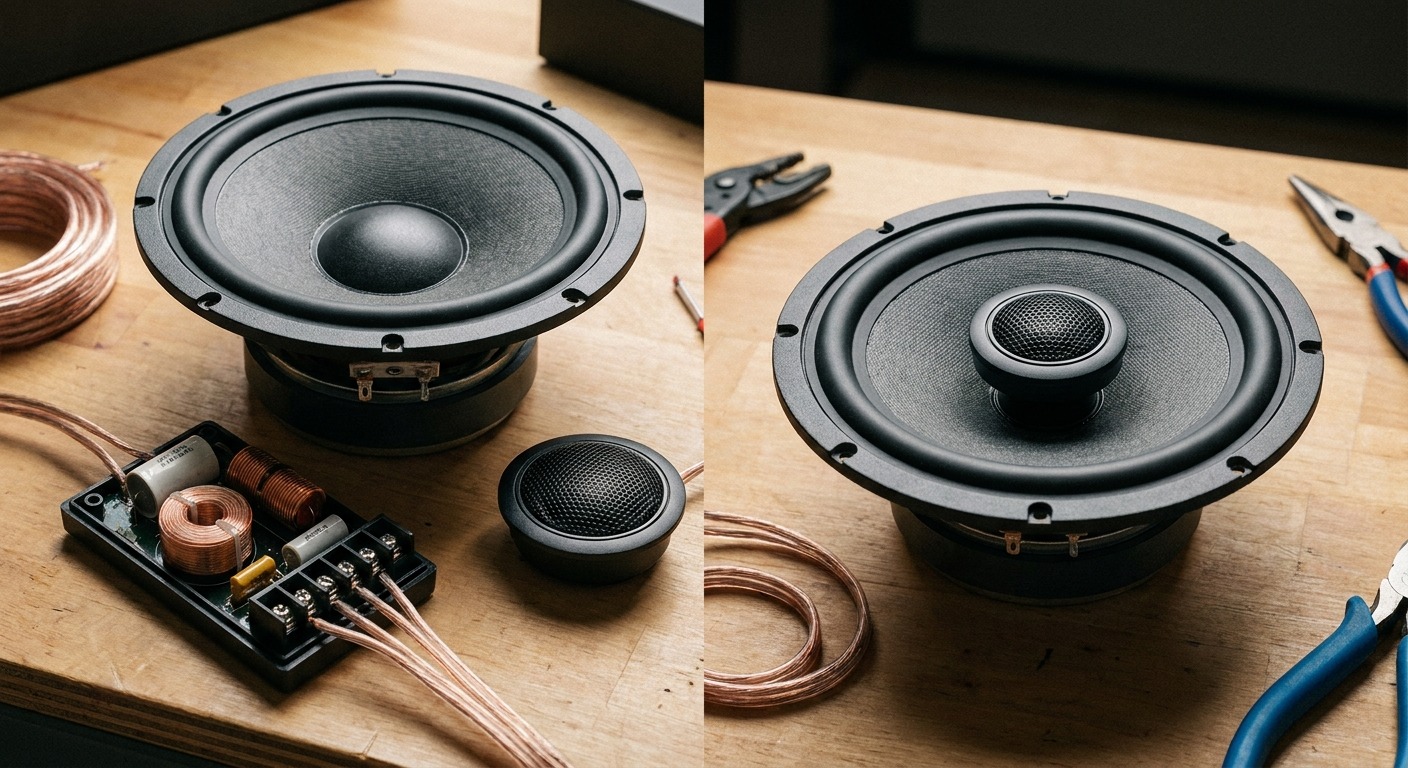
When you start shopping for car speakers, the first fork in the road is component versus coaxial. The car audio industry treats this like a simple hierarchy — components are "better," coaxials are "budget" — but the real answer is more nuanced than that. The right choice depends on your vehicle, your installation skills, your amplification, and honestly, how much you care about stereo imaging while driving on the 401 with the windows down.
What Coaxial Speakers Actually Are
A coaxial speaker combines a woofer and tweeter into a single unit that drops into a standard speaker location. The tweeter mounts on a post in front of the woofer cone, and a simple crossover splits the signal between them. Coaxials exist because car manufacturers provide one speaker hole per location, and that hole needs to cover the full frequency range.
The good coaxials use decent crossover components and well-designed tweeters. The bad ones use a cheap piezo tweeter that screeches above 8 kHz and a crossover that is literally a single capacitor soldered to two wires. The price difference between good and bad is not enormous, which makes the budget coaxial market a minefield.
Key point: A coaxial speaker is not inherently worse than a component set. It is a different engineering tradeoff: simpler installation and lower cost in exchange for less flexibility in tweeter placement and typically simpler crossover design.
What Component Speakers Actually Are
A component set separates the tweeter from the woofer. You get a woofer (typically 6.5 inches for door mounting), a separate tweeter (usually 1 inch or 3/4 inch), and an external passive crossover network that splits the signal between them. The woofer goes in the factory speaker location. The tweeter mounts separately — in the A-pillar, the sail panel, the dash, or a custom location — aimed toward the listener.
The external crossover is where component sets earn their advantage. Instead of a single capacitor, a proper component crossover uses multiple capacitors, inductors, and resistors to create steeper filter slopes, more precise crossover points, and better impedance compensation. A well-designed crossover can be the difference between a speaker that sounds natural and one that has an obvious tonal gap or peak at the crossover frequency.
The separate tweeter mounting is the other major advantage. In a coaxial, the tweeter fires from the same location as the woofer — usually down in the door, aimed at your knees. In a component setup, you can mount the tweeter at ear level, aimed at the listening position. This improves the perceived soundstage by putting the high-frequency energy where your ears can locate it spatially. Humans localize sound primarily using high-frequency cues, so tweeter placement disproportionately affects where the music seems to "come from."
The Crossover Question
Crossover design is the technical heart of the component vs. coaxial debate, and it is where the real performance difference lives.
A first-order crossover (6 dB per octave slope) is the simplest possible filter. It uses a single capacitor for the tweeter high-pass and a single inductor for the woofer low-pass. The problem is that a 6 dB slope does not attenuate very aggressively. At one octave below the crossover point, the tweeter is only down 6 dB — still playing frequencies that it is not designed to handle, at a level that is still clearly audible. This puts mechanical stress on a small tweeter and can cause distortion.
Most decent component sets use second-order (12 dB/octave) or third-order (18 dB/octave) crossovers. These provide much better separation between the drivers, which means each driver operates primarily in its designed frequency range. The tweeter is protected from low-frequency energy that could damage it, and the woofer is not asked to reproduce frequencies where it is beaming or breaking up.
Budget coaxials typically use first-order networks or simple capacitor-only filters. Mid-range coaxials sometimes approach second-order complexity. But the physical space constraints of mounting a crossover inside a speaker basket limit what is possible. An external crossover box has room for proper components — air-core inductors, film capacitors, wirewound resistors — that simply will not fit on a coaxial bridge.
The crossover is the least glamorous part of a speaker system and the most consequential. A great woofer and a great tweeter connected by a poor crossover will sound worse than mediocre drivers connected by a well-designed network.
When Coaxials Are the Right Choice
Coaxial speakers make sense in several common scenarios. If you are doing a simple drop-in replacement of factory speakers and do not want to fabricate tweeter mounts or run additional wiring, coaxials are the practical choice. They fit the factory hole, they connect to the factory wiring, and the improvement over factory speakers is immediate and significant.
Coaxials are also the right answer for rear fill speakers, if you use rear speakers at all. The rear speakers in a car do not contribute meaningfully to stereo imaging — their job is to add ambience and fill. Spending money on component sets for the rear is almost always wasted. A decent pair of coaxials in the rear doors, attenuated a few dB below the front stage, is more than sufficient.
If you are working with factory head unit power (15-22 watts RMS), the advantage of component crossovers is partially negated by the limited power available. The drivers in a component set and a coaxial set of similar quality will sound remarkably similar at low power levels. The component advantage becomes more apparent as you add amplification and play louder, where the crossover's ability to protect the tweeter and manage the transition between drivers becomes critical.
When Components Are Worth the Effort
Components earn their keep when you are running external amplification, when you care about soundstage and imaging, and when you are willing to do the installation work to mount tweeters properly. If you have a four-channel amp putting out 50+ watts RMS per channel, component speakers will reward that power with better dynamic range, more controlled behavior at high volumes, and a more convincing stereo image.
The tweeter placement advantage is real, but only if you actually mount the tweeters in a good location. Components with the tweeters surface-mounted on the door panel at knee level are giving up their primary advantage. If you are going to run components, commit to mounting the tweeters at dash or A-pillar height, aimed at the listening position. This might mean fabricating custom pods or drilling holes, which is why the installation is more involved.
For anyone building a serious car audio system with external amplification and a dedicated subwoofer, component front speakers are almost always the right foundation. The crossover flexibility, tweeter placement options, and overall build quality of a good component set will be the backbone of the system's sound quality for years.
The Installation Reality
Component installation takes more time. You need to run speaker wire to the tweeter location, fabricate or buy tweeter mounts, and potentially modify trim. In some vehicles, the A-pillar has a side airbag — always check before you cut. The crossover box needs a dry location behind a kick panel or under the dash.
Coaxial installation is straightforward: remove the old speaker, connect the wires, mount the new one. The most common issue is mounting depth — aftermarket coaxials are often deeper than factory speakers, and the magnet can hit the window mechanism. Measure your available space before you buy.
Key point: Measure your available mounting depth before ordering any speaker. The most common installation failure is an aftermarket speaker that physically does not fit in the factory location. Adapting rings and spacers can help, but they add depth rather than reduce it.
Price and Value
At the same price, coaxials and components from the same manufacturer often use identical woofer drivers. The difference is tweeter quality and crossover complexity. Under $80 for a pair, a good coaxial beats the cheapest component set. In the $100-200 range, components start pulling ahead meaningfully. Above $200, you should not be considering coaxials for the front stage.
The Practical Verdict
For a basic upgrade on head unit power with minimal installation hassle, get good coaxials. For an amplified system where you are willing to do the install work, get components for the front and coaxials (or nothing) for the rear. Do not waste money on components if you are going to surface-mount the tweeters on the door panel next to the woofer — you are paying for a mounting flexibility advantage and then not using it.
Whatever you choose, match it to proper amplification. Read our amplifier matching guide to make sure you are feeding your speakers the right power. And if bass is what you are really after, no door speaker of any type will give you what a properly enclosed subwoofer can. Understand the full system before you spend money on individual pieces. Our resources page links to communities where you can get vehicle-specific advice from people who have done the install you are planning.